 Shop Etsy
When we started sharing duck designs on MakerWorld, the goal was simple: encourage people to have fun with 3D printing. Print something, experiment, and maybe learn a new skill along the way. Every design was shared under the Standard Digital File License, which allows personal use while clearly restricting redistribution, selling, and derivative works.
Like most creators, we understood the risks. Over time, we saw our designs show up in places they didn’t belong; physical prints for sale, files reposted elsewhere. That clearly crosses a line and isn’t something we think should be tolerated.
What we saw recently, though, was different and it raised a more complicated question.
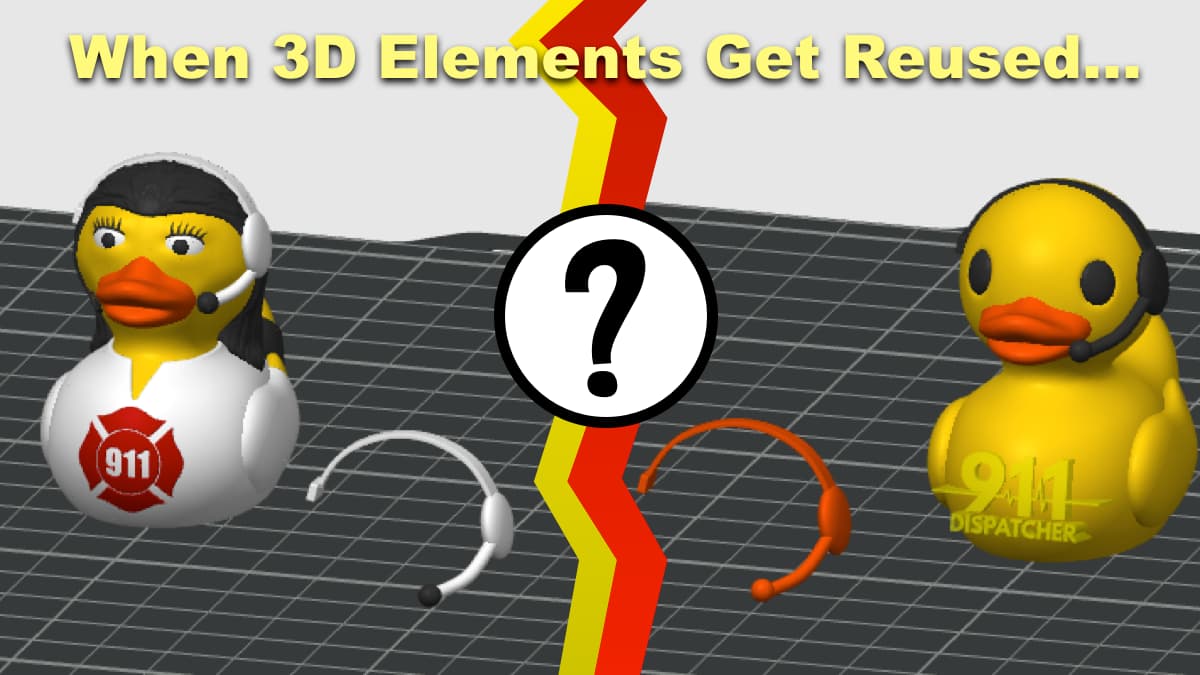
This time, it wasn’t an entire duck. It was a single part taken from one of our models and placed into another design.
At first glance, that might feel less severe. It wasn’t the full model, and the part itself is fairly simple. There’s no complex print-in-place geometry or hidden mechanism that took weeks to figure out. So the obvious question is: does that make it better? Or does it make it worse?
Because if the element is simple, then recreating it from scratch is well within reach. The tools are free. The learning curve is manageable. I know this because I didn’t start as a sculptor. I spent years in engineering CAD tools like SolidWorks and Shapr3D, but I didn’t touch digital sculpting until early 2025. Everything here came from learning, experimenting, and slowly improving—one model at a time.
That’s why this situation feels off. Looking at a model and trying to understand how it was built is part of learning. Lifting a part and reusing it skips that process entirely. It replaces effort with convenience.
We can’t claim absolute certainty, but the evidence is hard to ignore. The part is broken into the same pieces, segmented the same way, and when overlaid, the meshes sit identically on top of each other. Those kinds of matches don’t usually happen by accident.
Under the license these files were shared with, even reusing a single part still counts as a derivative work. Whether something is simple or complex doesn’t change that expectation.
So how upset does this make me?
Honestly, it’s less about anger and more about the principle. Stealing an entire design and selling it is clearly over the line. This was smaller—but it highlights a mindset that’s worth talking about.
If a part is simple, why not take the time to build it yourself? Look at how it’s made. Try to replicate it. That’s how skills grow. And if you’re going to borrow anyway, at least ask—or credit the work you’re building from.
Sharing only works when respect goes both ways. We want people to learn, create, and improve, just like we did. That means doing the work, not skipping it.
This isn’t a callout. It’s a conversation.
If you’ve experienced something similar, or if you see this line differently, we’d love to hear your thoughts. Join the discussion on our Facebook page and share your perspective.